Ethical Vibe Coding
A three-week course for high school students who build real apps with AI coding tools while learning to spot bias, dark patterns, and their own responsibility.
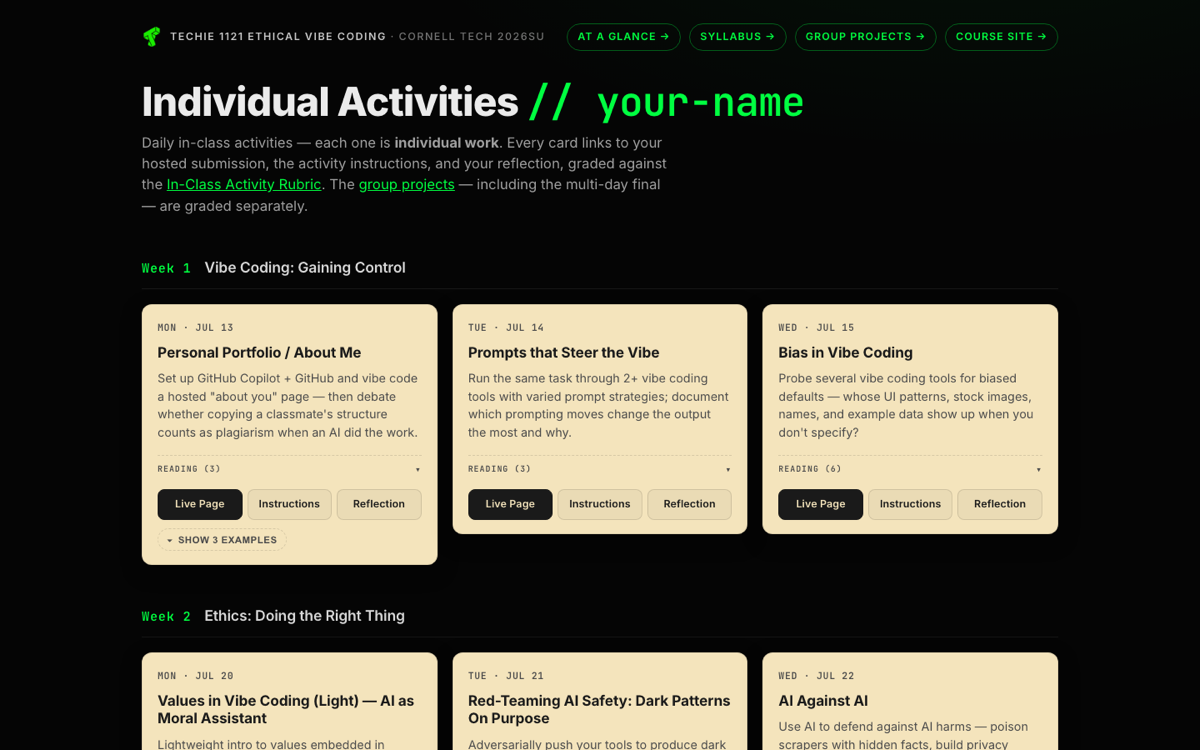
Good code, good vibes. TECHIE 1121 was a three-week course in Cornell Tech’s Summer Innovation Intensives for high school students with no programming background. Jonathan Segal and I designed and taught it, with Wendy Ju. Students built hosted web applications with AI coding assistants from day one, and every day ended with a written reflection. The course site is a 3D scene the students explored; its lite mode drops the 3D for screen readers and slow connections.
Week one, Vibe Coding: Gaining Control, covered the tools: a personal portfolio page, prompting strategies that steer the output, and a session on bias in vibe coding where students probe which names, stock images, and defaults the tools produce when nobody specifies them. Week two, Ethics: Doing the Right Thing, turned the tools on themselves: values in vibe coding with the Values at Play framework, a red-teaming day where students build dark patterns on purpose in order to recognize them, and AI Against AI, using AI to defend against AI harms. Week three was a multi-day group project.
Each in-class activity has a live page, instructions, and a reflection rubric, so the course site doubles as a reusable curriculum. The course grew out of my research on how students use generative AI in HCI prototyping classes (Sandhaus et al., 2025) (Parreira et al., 2026).
References
2026
- CHIWORK Workshop
 Visible Adoption, Untracked Contribution: GitHub Evidence of the Accountability Gap Across Three Cohorts of an HCI Prototyping CourseIn CHIWORK ’26: Adjunct Proceedings of the 5th Annual Symposium on Human-Computer Interaction for Work, Linz, Austria, Jun 2026Workshop paper at CHIWORK ’26 (workshop I co-organized)Abstract: Visible Adoption, Untracked Contribution: GitHub Evidence of the Accountability Gap Across Three Cohorts of an HCI Prototyping Course arXiv: Visible Adoption, Untracked Contribution: GitHub Evidence of the Accountability Gap Across Three Cohorts of an HCI Prototyping Course BibTeX: Visible Adoption, Untracked Contribution: GitHub Evidence of the Accountability Gap Across Three Cohorts of an HCI Prototyping CourseTLDR: Analysis of 203 GitHub repos across three HCI-course cohorts shows disclosure of AI-tool use grew to 66%, but explicit contribution attribution stayed rare — revealing an accountability gap in the vibe-coding era.
2025
- DIS
 Co-Designing with Transformers: Unpacking the Complex Role of GenAI in Interactive System Design EducationIn Proceedings of the 2025 ACM Designing Interactive Systems Conference, Funchal, Portugal, Jul 2025Abstract: Co-Designing with Transformers: Unpacking the Complex Role of GenAI in Interactive System Design Education arXiv: Co-Designing with Transformers: Unpacking the Complex Role of GenAI in Interactive System Design Education BibTeX: Co-Designing with Transformers: Unpacking the Complex Role of GenAI in Interactive System Design Education HTML: Co-Designing with Transformers: Unpacking the Complex Role of GenAI in Interactive System Design Education PDF: Co-Designing with Transformers: Unpacking the Complex Role of GenAI in Interactive System Design Education Slides: Co-Designing with Transformers: Unpacking the Complex Role of GenAI in Interactive System Design EducationTLDR: GenAI in Human-Computer Interaction education and design brings both benefits, such as enhanced creativity and faster iterations, and risks, including shallow learning and reflection. Students’ approach to GenAI, rather than the specific tasks performed, influences the success of GenAI co-design.